

Home DeePsy Pricing Contact

Evaluate, without surveying.

Deepsy branding stain

DeePsy optimizes your HR processes with a fun and innovative solution to help you detect potential

FREE DEMO In 5 min, no commitment

Schedule Meeting

Choose your DeePsy universe

Two approaches, one same requirement for measurable performance

The fusion between psychology and technology

Reliable

A scientific method that avoids response distortion

Fast

Completed in 5 minutes

Effective

Get only the relevant key elements

Fun

A gamified test that enhances the user experience
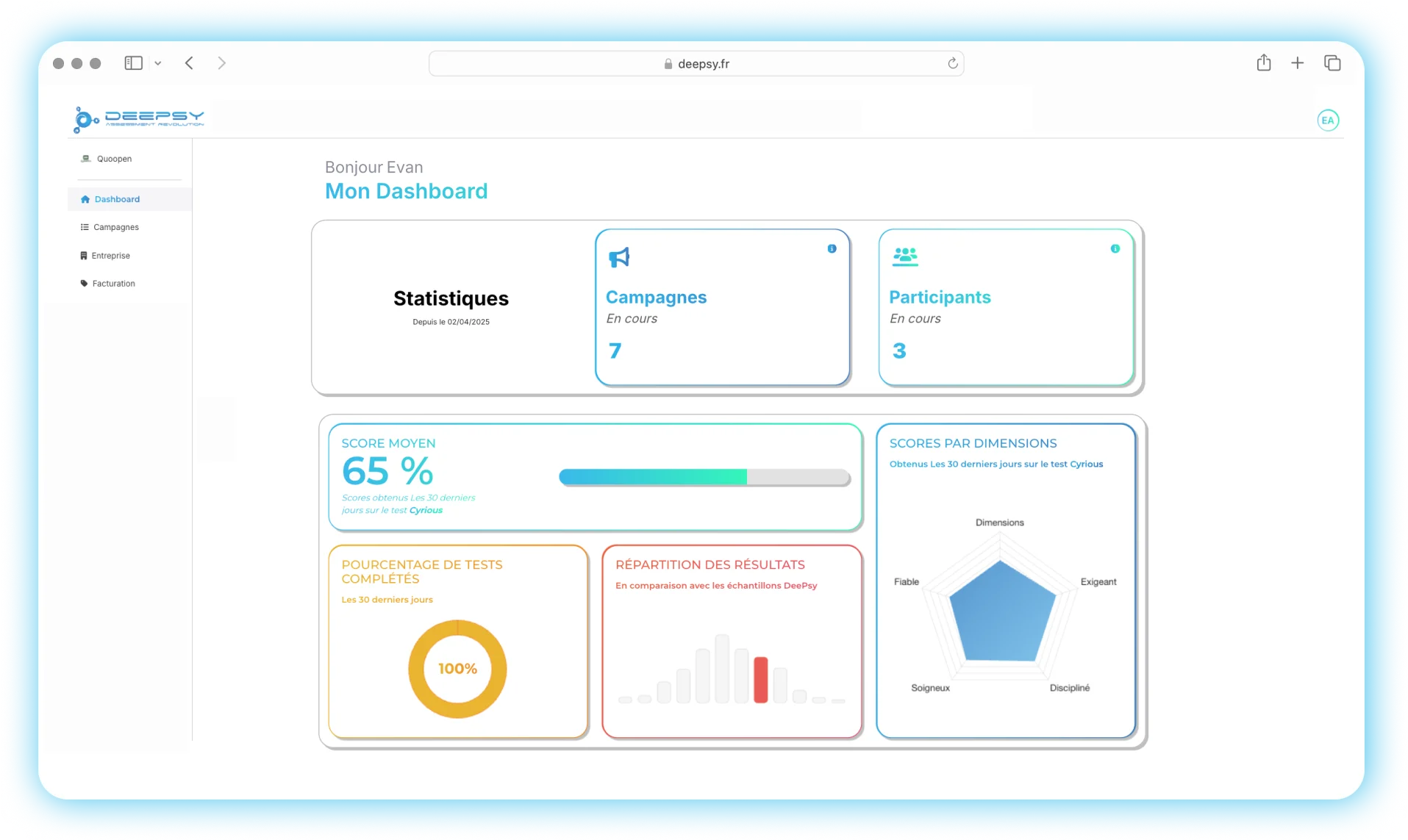
Recruitment

Computer

Recruitment

Create your campaigns and evaluate human potential to choose the most suitable candidate during the recruitment process.

Evaluate personality, motivation and soft-skills with a completely original approach.

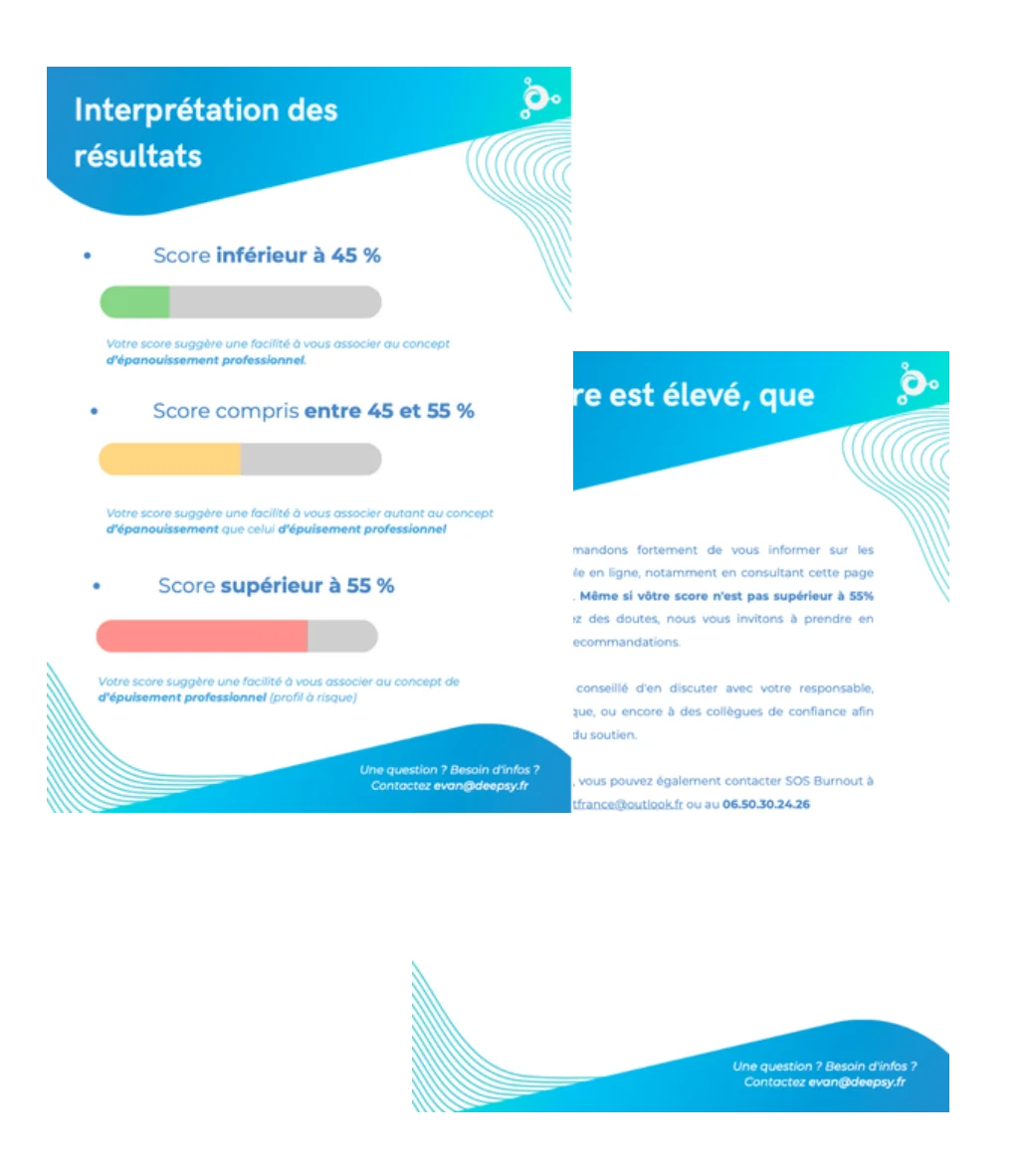
Quality of Work Life (QWL)

Evaluate anxiety, the risk of burnout, or even suicidal intentions.

These tests, achieving a reliability of 85%, can be used in the context of evaluating Psycho-Social Risks (PSR).
Computer

Prevent rather than repair: an economic imperative

Psychological disorders at work represent a considerable cost for companies.

€4,059

average cost of absenteeism per employee/year

+20% in recent years

150%

of annual salary to replace an employee

Recruitment + training + lost productivity

-35%

productivity with untreated disorders

Direct impact on performance

1 € invested = 2 to 4 € return

Thanks to reduced absenteeism, turnover and improved productivity.

Our approach: measure the invisible to act effectively

A complete 5-step system to transform mental health into a performance lever.

PSR Diagnosis & QWL Barometer

Enhanced by implicit measures

Measurement of psychosocial risks, detection of weak signals and scientifically grounded recommendations.

  • Absenteeism: -20 to -30%
  • Turnover: -15 to -25%
  • Satisfaction: +10 to +20%

Mental health audit

Transform data into decisions

Identification of root causes, prioritization of high-impact actions and definition of steering indicators.

  • Average ROI: 3:1
  • Overall performance: +5 to +10%

Manager training

Detect and act on weak signals

Early detection of psychological distress, adapted posture and faster managerial intervention.

  • Sick leave: -15 to -20%
  • Engagement: +10 to +15%

Targeted workshops

Strengthen collective resilience

Collective workshops on stress, burnout, communication and team cohesion.

  • Stress: -25 to -35%
  • Collaboration: +15 to +20%

Strategic support

Install sustainable prevention

Long-term framework, clear policy, robust governance and results-oriented continuous improvement.

  • Psychological costs: -30 to -40%
  • Strengthened employer brand

Investing in mental health, a strategic choice

Prevention is not just a moral obligation, it's a profitable investment.

Mental health prevention 2-4×

Per euro invested WHO Source

ROI Audit & actions

Average observed in companies

WHO ROI

Depression / anxiety WHO Source

Deloitte ROI

UK employers synthesis Deloitte Source

Manager training ROI 9.98×

Lancet randomized trial Lancet Source

Reduction of hidden costs

Up to 30 to 40% reduction in costs related to absenteeism, turnover and presenteeism.

Overall performance

Between 5 and 10% improvement in overall performance with structured prevention.

Employer brand

A clear mental health policy strengthens talent attraction and retention.

Security, confidentiality & governance

Your employees' trust relies on strict data separation.

Code of ethics

Strict respect of ethical principles and confidentiality of psychological data.

Aggregated data only

Campaigns can be configured in nominative or anonymized mode according to your needs.

GDPR compliance

Source anonymization, access traceability and documented data governance for each deployment.

DUERP integration

PSR assessments integrate into the Single Document according to INRS recommendations.

Our Training Programs

Adapted paths to equip your teams and managers.

2 days Design and deploy a PSR prevention plan in your organization

Learning objectives

  • Clarify the legal framework and strategic PSR issues for the company.
  • Build a PSR action plan articulated with the DUERP and HR policy.
  • Define monitoring indicators and prevention governance (steering committee, CSE, management).

Synthetic program

  • Mapping of PSR factors specific to your structure.
  • Prioritization of risks and choice of action levers.
  • Formalization of a structured plan: objectives, actions, responsibilities.
  • Construction of a PSR dashboard.
  • Steering modalities: role of management, CSE, etc.
  • Red thread workshop: action plan adapted to your reality.

Target audience: HR Directors, HR managers, prevention officers, CSE members, prevention relay managers.

5-day path PSR & QWL: build a global approach to improving working conditions

Learning objectives

  • Structure an integrated PSR–QWL approach aligned with the company strategy.
  • Equip internal actors to diagnose, prioritize and treat risk situations.
  • Install a culture of dialogue on work and activity completion conditions.

Path architecture

  • Module 1 (3 days): Current issues, diagnostic methods, identification of determinants, plan development.
  • Module 2 (2 days): QWL project management, animation of exchange times, monitoring and evaluation, co-development.

Target audience: QWL managers, prevention managers, HR Directors/managers, staff representatives.

2 days + virtual class Frontline managers: acting daily on PSR and QWL

Learning objectives

  • Enable managers to early identify individual and collective warning signals.
  • Develop managerial practices favorable to psychological health and work quality.
  • Know how to intervene as a first responder in a degraded situation, without replacing other actors.

Synthetic program

  • Understand PSR from concrete situations.
  • Identify observable indicators in the team.
  • Adjust management: clarification, regulation, feedback.
  • Conduct a regulation or alert interview.
  • Prevent managers' own suffering.
  • Virtual follow-up class (1.5 h) after 1–2 months.

Target audience: frontline managers, project managers, middle management.

1 day Set up PSR–QWL indicators and dashboards

Learning objectives

  • Build a simple, useful and shared PSR–QWL monitoring system.
  • Combine quantitative and qualitative data to inform decisions.
  • Organize information feedback and alert circuits.

Synthetic program

  • What a PSR–QWL dashboard should and should not do.
  • Inventory of available data (absenteeism, workplace accidents, surveys).
  • Selection of relevant indicators by job or unit.
  • Construction of a dashboard: periodicities, visuals, rules.
  • Organization of alert circuits and decisions.
  • Practical workshop: designing the framework of your own dashboard.

Target audience: HR, social management control, prevention officers, QWL managers, members of management.

1 day Psychosocial crisis management and post-event support

Learning objectives

  • Know how to react in a structured way to a serious event related to PSR.
  • Set up a crisis management procedure adapted to your context.
  • Organize team support and return to sustainable activity.

Synthetic program

  • Typology of critical events and human, legal, media issues.
  • Development of a crisis protocol: alert chain, roles of each person.
  • Internal and external communication in sensitive situations.
  • Psychological and organizational support devices.
  • Integrate lessons learned from the crisis into the prevention approach.
  • Case study: construction of a crisis management scenario.

Target audience: Management, HR, communication, CSE, occupational health services, managers.

Scientifically Proven Validity

IAT (Implicit Association Test) tests are supported by decades of rigorous scientific research, demonstrating their effectiveness in evaluating psychological traits.

Swipe to see more
2002

Predictive validity of an IAT for assessing anxiety

Egloff, B., & Schmukle, S. C.

Journal of Personality and Social Psychology, 83(6), 1441–1455

This study demonstrates that IAT tests can effectively predict anxiety levels, validating their use in psychological assessment.

2002

Implicit anxiety measure predicts cardiovascular reactivity

Egloff, B., Wilhelm, F. H., Neubauer, D. H., Mauss, I. B., & Gross, J. J.

Emotion, 2(1), 3–11

Research showing that implicit anxiety measures predict physiological responses to stress, confirming their biological validity.

2006

Predicting spontaneous Big Five behavior with implicit association tests

Steffens, M. C., & König, S. S.

European Journal of Psychological Assessment, 22(1), 13–20

Study demonstrating that IATs can predict spontaneous behaviors related to Big Five personality traits.

2020

Forecasting a fatal decision: Direct replication of the predictive validity of the Suicide–IAT

Tello, N., Harika-Germaneau, G., Serra, W., Jaafari, N., & Chatard, A.

Psychological Science, 31(1), 65–74

Direct replication confirming the ability of IATs to predict suicide risks, demonstrating their critical clinical utility.

2017

On the applicability of the Big Five IAT in organizational settings

Vecchione, M., Dentale, F., & Alessandri, G.

Current Psychology, 36, 665–674

Research validating the use of IAT tests in professional environments for personality trait assessment.

2004

Is the implicit association test immune to faking?

Steffens, M. C.

Experimental Psychology, 51(3), 165–179

Research showing that IAT tests are less sensitive to faking, making them more reliable for personality trait assessment.

These studies demonstrate the predictive validity and reliability of IAT tests in various professional and clinical contexts.

Discover DeePsy without commitments